
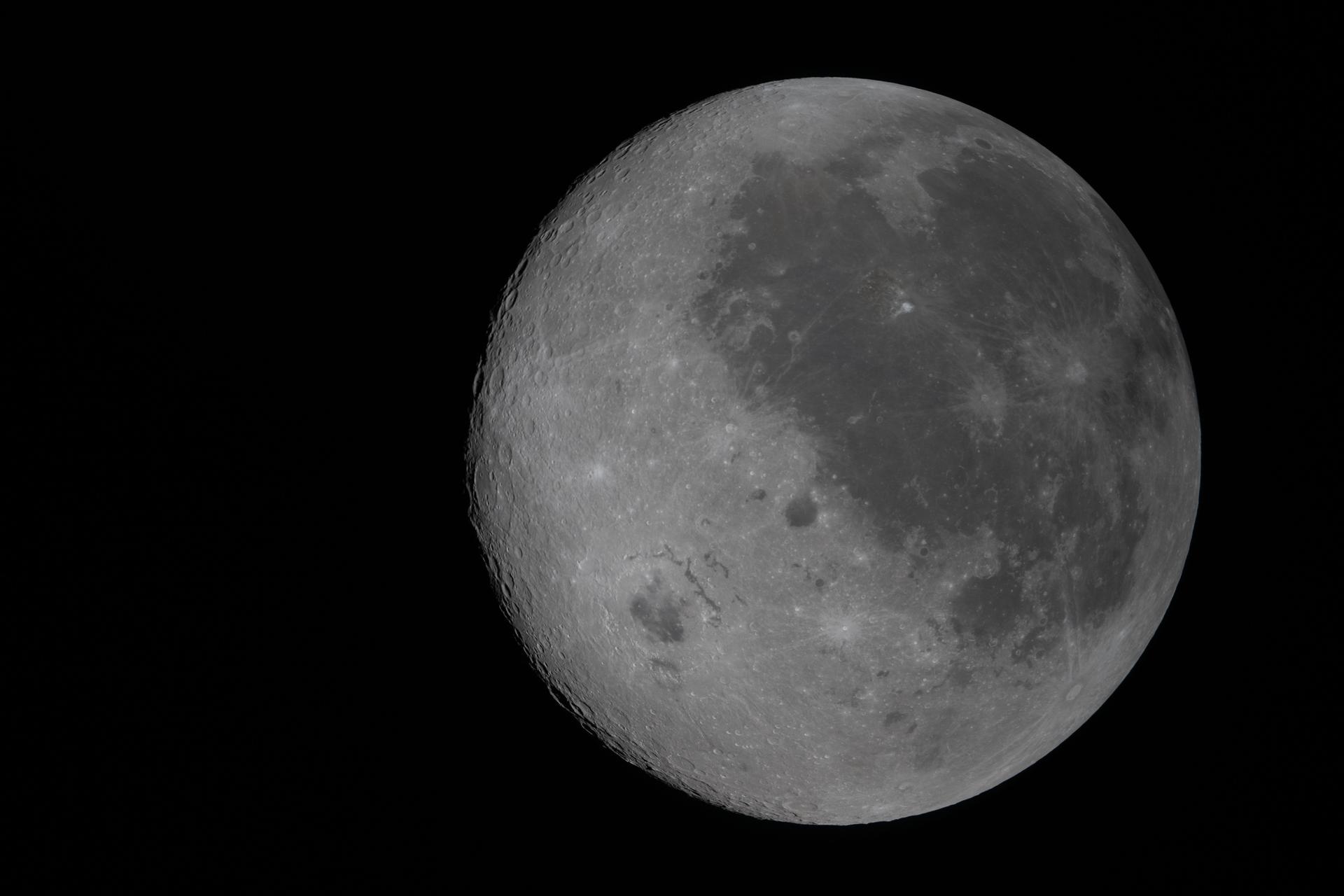
From Earth, we can only ever see the right half of this image — the lunar near side's ancient lava flows and the eastern rim of Orientale basin. Orion's cameras, currently deeper into lunar space than any crewed spacecraft in history, captured the crater in full today, with the Moon's farside on the left. The crew will get an even closer look later this evening as Orion swings behind the Moon entirely. Credit: NASA
Four astronauts have flown around the Moon today, the first crewed lunar mission since Apollo 17 in 1972. The seven-hour flyby took them farther from Earth than any humans in history — roughly 252,000 miles (406,000 kilometers) away, surpassing the record previously held by Apollo 13. The Artemis 2 crew of Reid Wiseman, Victor Glover, Christina Koch, and Jeremy Hansen passed within roughly 4,067 miles (6,545 kilometers) of the surface before swinging back towards Earth for an April 10 splashdown.
After passing behind the Moon from Earth’s perspective, out of ground contact for roughly 40 minutes, the crew then experienced a total solar eclipse from their perspective, flying into the Moon’s shadow. They experienced 50 minutes of totality, taking images and reporting on the appearance of the solar corona.
The crew has now started its return journey to Earth, and is scheduled to splash down in the Pacific Ocean off of Baja California on April 10 at around 8:17 p.m. EDT (5:17 p.m. PDT)
To get up to speed on the mission, check out our complete guide to Artemis 2 and explore the full mission timeline.
Our flyby live coverage has ended. Check back at Astronomy.com for the latest updates through the mission’s splashdown April 10.
Live updates
9:45 p.m. EDT: The science team signs off.
During the flyby, most of the communications from Houston have been handled not by the usual rotation of capsule communicators (CapComs in NASA parlance) but by Kelsey Young, who heads…